
Explaining a cost of delay can at times be a difficult concept, it is a form of opportunity cost which means it is a cost that doesn’t show on a balance sheet and is speculative in nature. Being speculative it is often overlooked or dismissed. This is disappointing as the cost is very real it is just the amount of impact that is speculative, overlooking it can have significant impact on your business.
This is a crucial discussion when helping business understand the benefit of Agile delivery, and DevOps in general. Too often the benefit of early release is lost entirely, or is limited to feedback or risk reduction.

A multi-million dollar decision.
As an example I worked with a client that had a set of features that they felt would save multiple-users, multiple-hours each day. They were working in an ‘Agile’ prioritizing work according to what provides the most value and working incrementally, but the software when done was put to a staging environment and held until a future planned release. Essentially they got feedback from users but the software was not deployed to production.
In this particular case the release was arranged around the availability of a trainer who was busy for a few months. When we added up the number of user hours that could have been saved by using the software before the proposed release date the lost of benefit was in the millions of dollars range. We could have hired 20 new trainers and still been profitable. A single constraint was costing them literally millions, but because it was an opportunity cost it never got flagged nor acted on. The plan was built around convenience of one group rather than what was best for the organisation as a whole.
And this happens all the time.
- The security group can only allow updates 4 times a year.
- Change control only meet once a month.
- The product would be immensely valuable but we can’t spare Sally from her current role.

Examples:
It is not always so clear cut but I wanted to create a tool that could help people simulate this and appreciate just how much of an impact Agile delivery can be on the balance sheet.
The actual cost of delay is heavily influenced by the lifespan of the product. The early release of a product with a very short lifespan could be significant, whereas the early release of a product that will last for 10 years may be relatively small, but in either case there is potentially money on the table that you are walking away from by delaying delivery of a product for reasons unrelated to the product itself.
For example, delaying for marketing reasons: say targeting an optimum marketing opportunity or event may very well be a good justification and may be worth the potential loss of value. But delaying due to resource availability or a process that only allows for scheduled time-slots or security policies that like to bundle all risks into set periods are likely to be costing your company significant profits in the belief they are being efficient.
Let’s take a look at a couple of very simple examples:
Simulations using the tool TicToc
The first is a situation where the expected lifespan of the product is set at 4x the time taken to develop. So a 1 year project would have a life span of 4 years and a 3 month project would have a lifespan of 12 months. (these settings are adjustable in the tool)
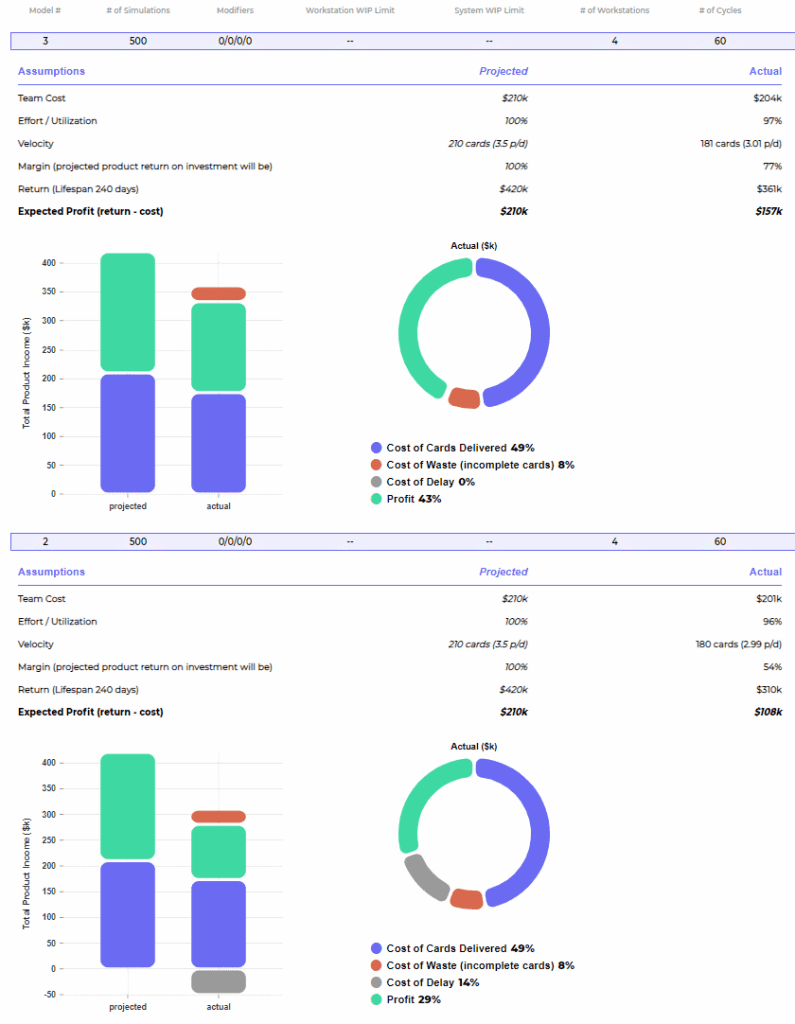
Here you can see that by deploying as a big bang at the end of development rather than realizing the value daily you have potentially lost 1/3 of your profit.
If we give a second example, one where the lifespan is much shorter – perhaps a tool target for a particular event. The impact is magnified. In this example the lifespan of the product is expected to be only double the development time, but the profitability is the same. i.e. the profit will be realized twice as quickly.
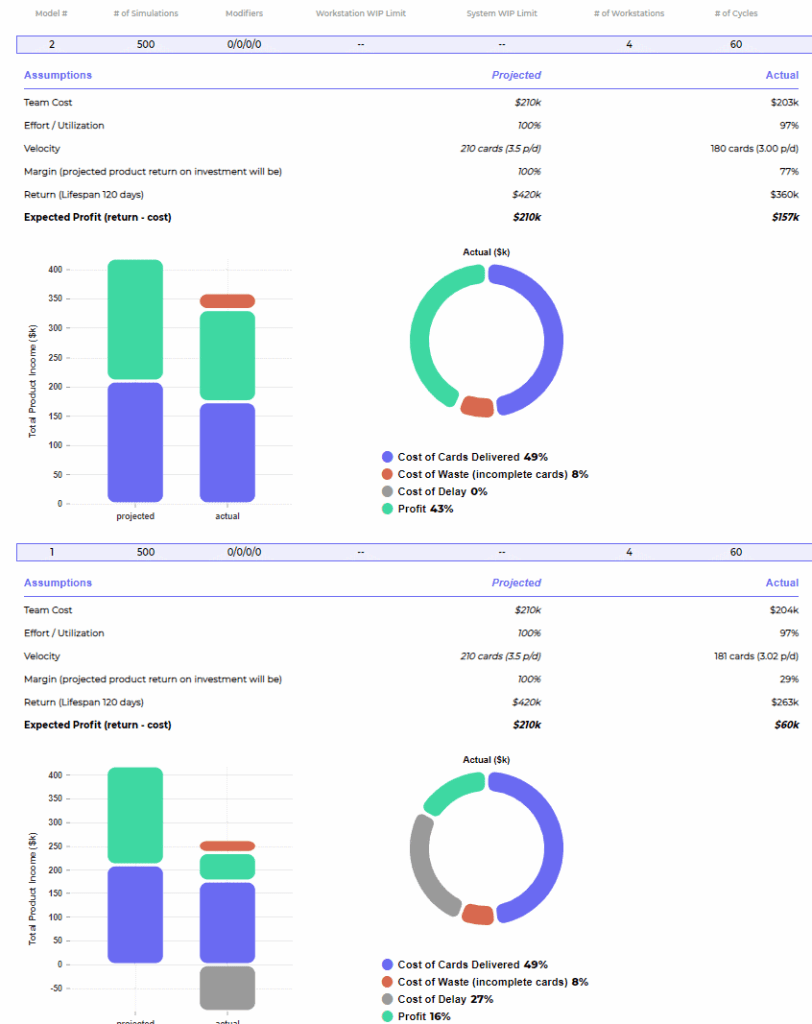
In this example a big bang delivery at the end of the product rather than daily deliveries would result is a potential loss of 2/3 of your profit.
What is startling is that these are not particularly unrealistic values. Expecting a profit margin of 100% (income double investment) and a lifespan of 4x the production time are not unusual. Many companies operate on margin’s considerably less than 100%.
Your business could be losing out on significant amounts of profit simply because you are planning releases around convenience of a few people. You could be putting profits at risk by optimizing for concerns that are not as important.
Please configure the tool to represent your expected project outcomes and see for yourself how much that Big Bang delivery could be costing you in profits.
 TicToC